Table of contents for Short Rows & Sock Heels
- Short Rows, Deconstructed
- The Double-Stitch Short Row Heel – aka the “yo-yo” or “jo-jo” heel
- Roomier Short Row Heels
- Sasquatch Report
So — a few weeks ago, I wrote about sock heels. How I don't really like flap-and-gusset style heels, and how the EZ afterthought heel usually seems too small for me, and how I'd been checking out all kinds of short row heels, in my search for the Best Short Row Heel of All Time.
I did knit an awful lot of sock heels (some of them truly awful).
And then… I found The One.
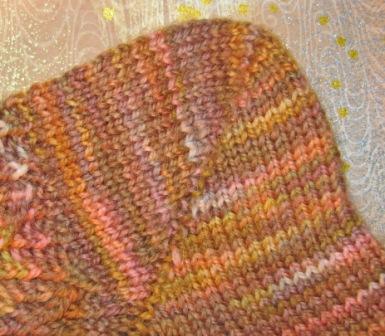
This particular heel style seems to be (1) not very common, and (2) decidedly German in its heritage. I've only found it online a couple of places: one mention of it on an native Austrian knitter's blog, and instructions for it on the Lana Grossa site (which seems to be down for the count these days). In print, so far I've found it only in a Regia pamphlet.
This is a shame, I think, because this heel has a lot of positive qualities. It's easy to do, once you know what it is you're supposed to do. It makes a darned nice heel, IMHO. It is not prone to gaps, nor does it require weird backwards YO's, nor does it have odd-looking decreases up the sides. The whole wrap & turn thing? Forget it. And the inside looks practically as nice as the outside.
And, it adds one more thing to EZ's famous list of "things you can do wrong when you're learning to knit that turn into a technique later on." You know how beginners sometimes take the yarn the wrong way over the top of the needle when they are starting a row? Guess what? There's a use for that. Trust ingenious German engineering to come up with one.
All that – plus the fact that I can't quite wrap my head around what exactly is going on with the short row turns – just fascinates me. I'll get it figured out someday, but for now, I'm content to just be impressed.
In fact, the only thing I don't like about this heel is… the name. Yup, once again, I have a nomenclature problem.
It's called the Yo-yo heel, or sometimes, and even more incomprehensibly, the Jo-jo heel. I think both of those sound, well, stupid. (And there aren't any "YO's" in it, anyway. Let alone whatever a "JO" is, or might be.)
So, following in the great historical tradition of knitters calling things by different names, I have decided to call it the Double-Stitch Short Row Heel. And here's how to do it –
Please bear in mind that the light orange example shown in these pictures is knit at a much looser gauge than usually used for socks — mainly because I used my size 9 ebony needles, in order to clearly show what's going on. Thus the finished example heel may look kind of loose and hole-y – but at sock gauge, it's marvelous. Would I lie to you? About knitting?
Double-Stitch Short Row Heel — First half
K across all heel sts, turn.
First WS row:
- Hold yarn to front, slip next st pwise.
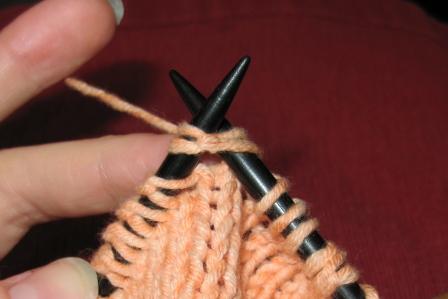
- Take working yarn to back over RH needle; then take working yarn to front between needles, pulling snugly so that the slipped st falls to the back, and the stitch in the row below is pulled up over the RH needle – WS double st made.
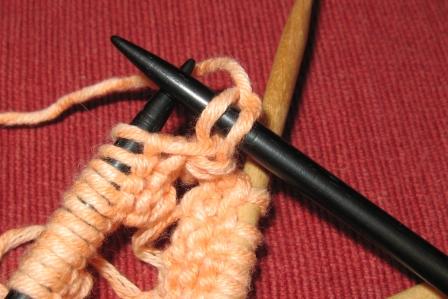
- Keep the working yarn to the left of the slipped st as you bring it over the RH needle, so the st that is pulled up from below IS NOT twisted.
- P back across rem heel sts, turn.
First RS row:
- Hold yarn to front, slip next st pwise.
- Take working yarn to back over RH needle; pull working yarn snugly to back, so the slipped st falls to the back and the stitch in the row below is pulled up over the RH needle – RS double st made.
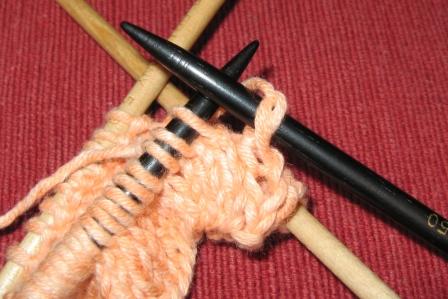
- Keep the working yarn to the left of the slipped st as you bring it over the RH needle, so the st that is pulled up from below IS twisted.
- K heel sts up to, but not including, the double stitch from the previous row.
** Next WS row: Make WS double st; then P all the normal sts up to, but not including, the double st(s) previously made. Turn.
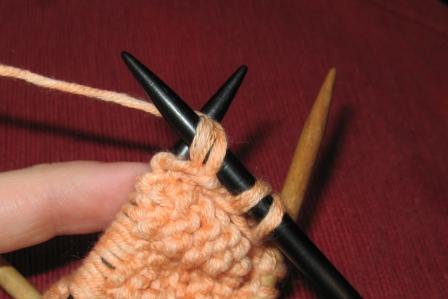
Next RS row: Make RS double st; then K all the normal sts up to, but not including, the double st(s) previously made. Turn. **
Continue to repeat last 2 rows (between **), making double sts at beg of each short row, until your heel is divided almost into thirds:
- one third double sts on the left,
- one third plain sts in the middle + 1 extra st,
- one third double sts on the right, except 1 st short.
You should be about to work a RS row – which will take one more plain st from the middle and turn it into a double st. Then everything will be nice and tidy.
Last RS row: Make RS double st; then K all the normal sts across the middle of the heel up to the double sts.
Continue to knit across left side of heel, working the double sts by inserting the RH needle under both forward loops of the double st, and knitting as if for a k2tog. (Be careful to pick up both front loops, and only the front loops.)

Continue working around whole sock now, across instep sts. Knit the double sts on the right side of heel in the same manner. Work around most of the sock a second time, across the instep sts, and stopping when you are about to work the heel sts again.
Second half of heel
K across 2/3 of the heel sts, turn.
First WS row: Make WS double st, P back [one third of the heel sts, minus the one you slipped], turn.
For example, on a 36 st heel:
First, knit across 2/3 of the sts = 24 sts. Leave 12 sts of the heel unworked on left side.
Turn and use 1 st to make the WS double st, then purl back over
(1/3 of the heel sts – 1) = (12 sts -1) = 11 sts.
Now 12 sts on the right side of the heel also rem unworked. Turn.
** Next RS row: Make RS double st, K to double st of prev row, K the double st, K1, turn.
Next WS row: Make WS double st, P to double st of prev row, P the double st, P1, turn. **
Continue to repeat last 2 rows (between **), until you have purled the last st of the right side of the heel on your last WS row.
Last RS row: Make RS double st, K to double st at end of heel, K the double st. Heel is complete. Continue working around sock. One double st will rem at the beg of the heel, which will be worked on the next round.
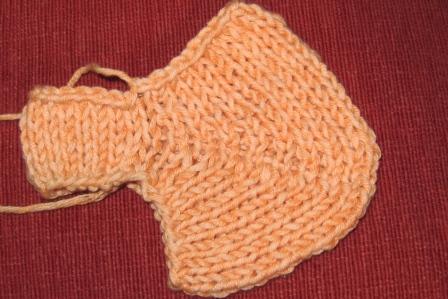
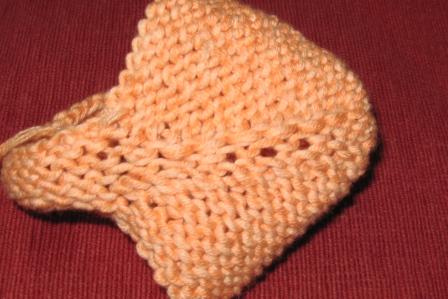
Nice, eh?
#1 by sandy elardo on May 7, 2008 - 9:08 PM
Quote
Maybe the name for this heel (if it is indeed a German heel) was originally “jo jo” and Americanized to “yo yo” because in German a “j” is pronounced like a “y”.
Are you going to write a whole sock pattern using this heel?
#2 by TessM on May 8, 2008 - 9:10 AM
Quote
Hey Sandy, that’s interesting information! But what would “jo-jo” mean in German??
This heel is what I wrote into the Kenkyo sock pattern. One of the reasons it took me so long to get that pattern done is, I was trying all these other heels and stuff. I really like this heel though (can you tell?)!
#3 by plumbum on May 15, 2008 - 10:02 AM
Quote
Many thanks for this, you have saved my sanity. My heel is not perfect but is now far better than the sorry mess I achieved, and had to frog, following the pattern instructions for the sock that I am currently making.
I think that I may now be in love with you. May I have your babies?
#4 by TessM on May 15, 2008 - 10:12 AM
Quote
You’re quite welcome — so glad to know that this was helpful for you! I really do think this is a great heel style.
Hmmm… babies? kind of you to offer… maybe you can do some knitting for me instead??
Pingback: Roomier short row heels | TessKnits.com
Pingback: Sasquatch Report | TessKnits.com
#5 by Janine on June 20, 2008 - 9:18 AM
Quote
Hi, The Jojo heel is called a yoyo because its like a yoyo in its action, it goes back and forth like a yo yo only a bit less each time IYSWIM.
I love the Boomerand heel too, Its very pretty and also very main-stream looking too. It really makes the sock look shop brought and not homemade.
I always think of this stich not as a double stich but as a slipped stich with yarn in front that is pulled way way too tight. LOL
I am going to link this to a friend
#6 by Carol in Denver on July 27, 2008 - 10:43 AM
Quote
Tess,
Thank you SO MUCH for researching this technique and publishing the very clear tutorial on the double-stitch sock heel.
I’m an experienced knitter but a beginning sock maker. I tried the other mainstream method of short-row heels on my first sock & was really dissatisfied. I used this method on the 2nd sock of the pair and am thrilled. I look forward to a whole new passion of sock knitting!
#7 by sandrajean on August 10, 2008 - 8:55 PM
Quote
Thank you for these instructions. The pictures are especially helpful.
#8 by Maris on August 11, 2008 - 9:36 AM
Quote
I have been using this heel since I found it in a Kaffe Fassett Regia design pamphlet. There it is called a “Round Heel”. It is a great heel!
#9 by Julie Stalnecker on September 24, 2008 - 9:35 PM
Quote
I am just starting to knit socks for Christmas, using the K Fassett yarn, and the pamphlet instructions are a disaster. Thank you for your fabulous site. I have bookmarked it! I tried your Polar Bear site and the link did not work. I will return. Again thank you, Julie
#10 by TessM on September 24, 2008 - 10:59 PM
Quote
Hi Julie! thanks for the compliments! and glad I could help.
Not sure why the PBP link didn’t work but I’ll check into that… you can always type in “polarbearpatterns.com” though. See you around!
#11 by Danielle on October 28, 2008 - 5:18 PM
Quote
Your site explained that you had seen this new heel pattern in a Regia pattern pamphlet. I have this pattern but am having trouble with the start of the heel. Can you please explain the beginning of the heel-starting with the dividing stitches. It says to divide the stitches onto 3 needles, which I did, then knit all the way across. The problem is that when I split the stitches onto the 3 needles my working yarn is in the middle of the new middle needle so when I knit the stitches across, I have only knitted half on the new middle needle and knit across the 4th needle. I haven’t done anything with the 1st needle. I am not sure what I am missing except I have divided the stitches wrong. Please advise-thank you.
#12 by TessM on October 29, 2008 - 12:40 AM
Quote
Hi Danielle, I sure hope we have the same pamphlet! Mine says things a little differently than what you have described… I’ll paraphrase a bit here:
Work the heel back and forth over the sts on needles 1 and 4. Arrange the heel sts in 3 sections as given in the table (which is more-or-less in thirds).
Given that my pamphlet’s directions also say the end of the round is between needles 4 and 1, I think I can envision why your working yarn would end up in the middle of your heel!!
Basically what you want to do though, is work the heel over half of your sock’s total sts, and it technically doesn’t much matter which half. If you don’t have any kind of design on the leg of your sock, you can freely start the heel pretty much over any sts you want. Just work across half the total sts — in my directions above, that’s where I say “K across all heel sts, turn” — then start doing the short rows.
If your sock is plain, the simplest thing for you to do is just work the heel over needles 1 and 2, not needles 4 and 1.
If OTOH your sock has some kind of design, then pick the sts for the heel such that the design is centered, or wherever you want it to be, with respect to the heel.
Hope that helps!
#13 by Melissa on November 14, 2008 - 12:58 PM
Quote
I got me a new heel!!! I am going to work this for all my toe ups and will probly figure this out but….When I go thro the double stitch on second half, knit or purl side, am I to pull the stitch around where I knit/purl thro the front of it? I went thro the back of those stitches (cuz it was most handy) and now I have “ladders” all thro the seams. Or am I not pulling tight enough when I make it originally. Please respond. I LOVE this heel and want to get it right. I will be posting this tut on Yahoo socknitters group and knittinghelp.com so EVERYONE can love it too. Thank you for finding it for us!!
#14 by TessM on November 14, 2008 - 8:06 PM
Quote
Hey Melissa, glad you like it! As for knitting the doubled sts — I’m not quite sure what you mean by “pull the st around”, but you should not be working into the back of the doubled sts. They should be just the same as on the first half of the heel.
On that note, it’s worth mentioning that at the end of this post is an explanation and examples of my successful experiment with doing the first half of a short-row heel twice. You may want to take a look at that if you are having trouble with the second half. In fact, with most if not all of the SRHs that I tried, the first half almost always looks way better than the second half — and you could use this trick with any two-part SRH method. Cheers!
#15 by Susan on December 4, 2008 - 10:10 PM
Quote
Thanks for this explanation – I have the Regia pamphlet and was stumped! Now I’m on my way!
#16 by Karknits on January 2, 2009 - 9:17 AM
Quote
Thanks for this. I managed to figure out how to do this from the Reggia pamphlet but it was VERY confusing. My socks are a little tight around the front of the ankle. I would like to work out how resolve this problem. I think perhaps the answer lays in working the heel over a greater number of stitches. I think this heel looks amazing. It is so neat and gives a professional-looking finish akin to manufactured socks. Too bad the the Reggia pattenr is so poorly written – I think it has put a lot of people off trying this heel…
#17 by claire on February 14, 2009 - 11:37 AM
Quote
Dear Tess
I too have the Regia pattern. I have asked 4 experienced sock knitters all of whom siad ‘forget it, do flap style’. Now I have found this site I will give it a try as I prefer the less ‘homemade’ look. Thanks for the clear instructions.
There is also a utube by Cat someone on a ‘wrap ‘ heel that shows a slightly different wrap, but the end result is very similiar.
#18 by TessM on February 14, 2009 - 12:53 PM
Quote
Hi Claire! I hope you don’t give up on this heel style without giving it a try. Of course, everyone has their own preferences, which I think mostly come down to fit and how it feels in the end — but there is one more big advantage to a short-row style that came up the other day.
This Friday I had a student bring me some of her favorite socks which had worn out at the heel, and of course they were flap & gusset — which is pretty much impossible to repair. If you do a short-row style heel — this one or any of the others — they can be taken out and reknitted relatively easily. You end up doing something like Elizabeth Zimmerman’s “Afterthought heel”. But it beats throwing out your favorite pair of socks!
#19 by Mary G on April 12, 2009 - 7:56 PM
Quote
Thank you!!! I’ve spent two days trying to find simple instructions for short rows. I get the concept but also got holes for all my efforts. I found your tutorial today and have just completed a very nice practice heel. It’s pretty and has no holes!!! TA DA!!! I’m ready to work on more socks. Really, I’m only slightly addicted to socks..since last November and a “sock” class.
#20 by chris on August 15, 2009 - 6:03 AM
Quote
I am sitting in front of the Regia pattern in a complete daze (despite having knitted socks before!). Thank you for your tutorial, I am about to try the short row heel. As others have noted, the Regia original is almost unfathomable.
Pingback: Sock Design 101: Part 4 | TessKnits.com
#21 by Randy H on September 13, 2009 - 11:53 AM
Quote
Thanks, Tess.
I’ve been searching for a good explanation of this heel. I emailed you a picture of some ‘old timey’ socks made in this manner.
with photos
Randy
Pingback: Ripple~Wave Socks « knitter gal
#22 by Carol in Denver on January 17, 2010 - 11:41 PM
Quote
Just checking in with a New Year’s report — I’ve done 5 pairs of socks now using Tess’s instructions for the double-stitch heel, and am still in love with the technique. Beautiful, fast results.
All you 3000+ viewers of this page, are you using this heel? Or something else? Surely you-all have experiences that will help the timid…
#23 by TessM on January 18, 2010 - 9:09 AM
Quote
Carol, glad to hear this is working so well for you! You go, girl!
#24 by LiLo on January 28, 2010 - 2:55 PM
Quote
Another sock newbie here! Having the whole, holey issue, too.
Perhaps I’m still too green at this point, but I can’t grasp this…Can you do a video? ;^) I know it’s a lot of work, but, if interested, it would be mighty helpful to knitting “dummies” like moi :^)
I, myself, have vowed to one day put up a youtube or something of a full-on sock! It is so frustrating to see just bits and pieces, and, to top it off, the hardest parts which are transitions (when and *exactly* where on the work to start “x” technique) is almost always zipped through, unshown, or, worse, with the assumption the viewer already knows what they mean :^(
Either way, thanks for this!
#25 by TessM on January 29, 2010 - 9:51 AM
Quote
I would say a video is a good idea, but I tried to post one around Xmas (on a different topic) and had “issues”. I hope to be able to figure out all that stuff soon though!
#26 by Jane on January 29, 2010 - 8:07 AM
Quote
Hi Tess – Thank you for such a great tutorial – I’ve been searching for the perfect short row heel and this is it, worked out perfectly on the first practice try thanks to your clear instructions and pix. Love your site, really glad I found it.
#27 by TessM on January 29, 2010 - 9:52 AM
Quote
Thx Jane! always good to hear it helped someone!
#28 by Wanda Stemen on April 8, 2010 - 4:46 PM
Quote
Hi,
I am an IT person and need to visualize what I am doing. So I sat down and created a spreadsheet with the Jo Jo Heel pattern. Mine is using 48 sts, 24 per needle. I think it will be helpful. Where can I send it?
thanks
Wanda
#29 by TessM on April 9, 2010 - 10:17 AM
Quote
Hi Wanda! Thx for your willingness to share!
You could send your info using the “contact” link (at the top of the page in the blue bar), which will get you to a page that has a link to click on to send me an email. (Sorry, it’s a little convoluted, but it’s one way to keep the spam down.)
#30 by Carol on July 22, 2010 - 1:45 AM
Quote
Hi Tess,
Like lots of others here, I was struggling with the Regia pattern and have found your instructions very good. You made it much more obvious that you need to slip the stitch before making the double stitch.
I’m finding it tricky a) making the double stitch on knit rows, for some reason – the stitch doesn’t pull over very easily, and b) working with double-pointed needles doing purl (it is easy doing knit but for some reason is far more fiddly to purl). But your instructions more or less bailed me out!
#31 by Carol on July 22, 2010 - 3:15 PM
Quote
Hi again. My heel seems to be working OK, except that I am finding it difficult to make the double stitch on knit rows – the stitch underneath seems much too tight to want to pull over the needle. The one on the purl row works fine. Does anyone have any advice on this problem?
#32 by Carol on August 1, 2010 - 2:36 PM
Quote
Hi Tess, I’m not sure if you’re still monitoring this page, but wanted to say once again – THANK YOU for your great instructions. I have just knitted my second heel and it is darn near perfect.
#33 by TessM on August 3, 2010 - 4:02 PM
Quote
Hi Carol! I’m still here but have been so busy with moving and getting the old house rented (hooray) and writing the material for the top-down sweater class, I basically have taken the summer off from blogging. Glad you are liking the heel!
#34 by Carol on August 15, 2010 - 4:21 PM
Quote
Well thanks again Tess. I have now knitted two pairs of socks and am just getting into the groove .. Best wishes with all your ventures. Carol
#35 by TessM on August 16, 2010 - 1:19 PM
Quote
awesome! I’m getting back into the (blogging) groove too!